Wednesday, September 30, 2020

not explicitly stated (Part 3)

If you have not, please read parts 1 and 2 prior to continuing.

At the end of Part 2 I wrote:
"...'Communism is for us not a state of affairs which is to be established, an ideal to which reality [will] have to adjust itself. We call communism the real movement which abolishes the present state of things. The conditions of this movement result from the premises now in existence.' The German Ideology
What is the present state of things? What group of people is pointed at for making up the modern bourgeois of the 21st century?"

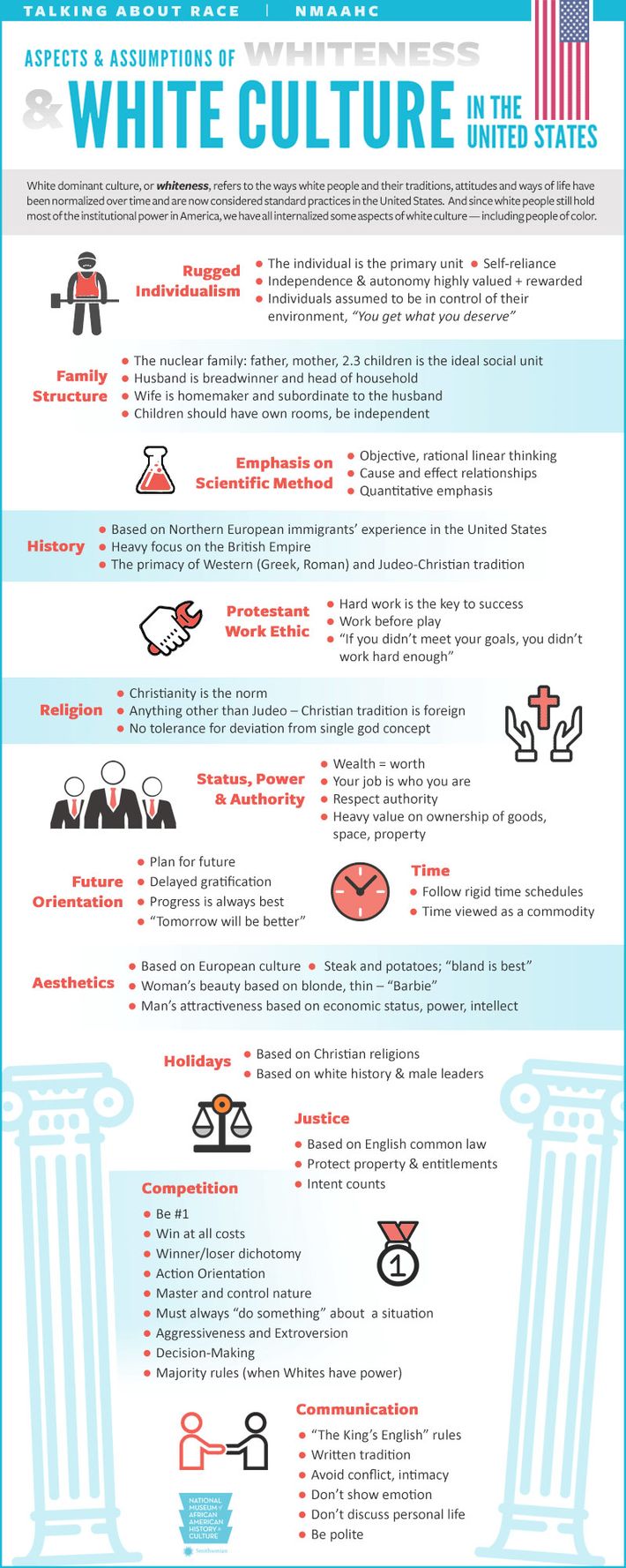
If you haven't guessed who the bourgeoisie are yet, perhaps this picture might help:
Don't forget that the most effective strategy towards abolition of the bourgeois, is whatever can be used to rouse the majority of the proletariat to action.
...They openly declare that their ends can be attained only by the forcible overthrow of all existing social conditions. Chapter IV Communist Manifesto
White people and their culture make up the modern day bourgeoisie. They have to include "white culture" because it is anyone of any race who lives their lives and raises their families in the white culture way.
"...we have all internalized some aspects of white culture-including people of color."
Remember the words of Marx, "Law, morality, religion, are to him (proletariat) so many bourgeois prejudices, behind which lurk in ambush just as many bourgeois interests". 

The above poster was posted by the National Museum of African American Culture and History. It was also posted along with an article about whiteness. 1 

They quote Toni Morrison in the beginning with this:
"In this country, American means white. Everybody else has to hyphenate."

No offense to Ms. Morrison but no, no you don't. The first instance that can be found of the term actually came from a sermon written in 1782 in which a preacher refers to himself as African American. This was a year before the Revolutionary War ended and 79 years before the civil war even began. 2

According to the same site, hyphenating was popularized by none other than Jesse Jackson as a preferred alternative in place of calling someone black.

This whiteness article claims to want "to foster and cultivate conversations that are respectful and constructive and provide increased understanding." "What's wrong with that?" one may ask. It is what's unspoken. What they really mean is "increased understanding on part of white people". It only desires a one-sided understanding. To get you to understand your white privilege and that white people need to understand that they have been complicit in the biases stemming from systemic racism. 

You can't say "but wait I'm not racist", that just further proves you are. The more you fight, the more guilty you are. If you say you aren't then prove it, become active anti-racist activist allies. Join them to fight against the system ie the bourgeoisie.

The definition of racism is prejudice against those of different races, feeling your race is superior above all others. By this definition anyone can be racist. However, now that we are able to redefine terms it has been redefined as prejudice + power and I believe success would be a part of that redefinition. 

Yes, there have been and still are individuals who hold prejudices based on skin color but they do not have widespread power to dictate the affairs of the country. The claim that the whole system is inherently racist has no leg to stand on when you know that power and success are had in all races within our system today. That's why it is "whiteness" or "white culture". That way you can say that whoever is successful within the system have only been able to do so because either they are white, can pass as white, or they must have conformed to the "white culture" way. Their voices in defense of said system are now irrelevant.

"...don’t wrangle with us so long as you apply, to our intended abolition of bourgeois property, the standard of your bourgeois notions of freedom, culture, law, &c. Your very ideas are but the outgrowth of the conditions of your bourgeois production and bourgeois property, just as your jurisprudence is but the will of your class made into a law for all, a will whose essential character and direction are determined by the economical conditions of existence of your class." Chp II Manifesto

You may be familiar with the following terms and if you are not, you need to be:

Cultural Appropriation
White Privilege
White Fragility
Solidarity
Comrade
Socialism
Collectivism
Critical Race Theory
Systemic Racism
SJW (Social Justice Warrior)
Identity Politics
Woke
Cancel Culture
Revolution (cultural)
True Democracy (true majority rule, no electoral college for example)

Appropriation was not a normal casual word in everyday conversation but all of a sudden it was everywhere. Then I read the communist manifesto and it all became clear. The word appears 14 times within the manifesto itself. There is no way that this came from anything but Marxism when using it in the context of "white people stole this from such and such culture".

I have stated multiple times that Marx only gave the tools to destroy. The goal of neo-Marxists is to exterminate "white culture" from existence, to rip out from under us the very foundations of our nation. They do that by destroying the images of the founding fathers and the history of America. If you accomplish destroying that legacy everything they did and/or said becomes null and void. This includes the Constitution, this includes the Bill of Rights, this includes the Declaration of Independence. This includes our very legitimacy as a country, as a nation. We lose our identity and once that's gone we are ready for remolding.

They cannot accomplish their goals without destruction. They must destroy anything that they feel is made in the image of the current bourgeoisie:
"...religion, family, state, law, morality, science, art, etc." Private Property and Communism 
They must silence every voice that disagrees with them and if you defend the system you are a white supremacist regardless of race.

They must reprogram and reeducate. Critical Race Theory Training is such a program. It is NOT sensitivity nor diversity training.
"The task of the new communist schools is to impose upon bourgeois and petty-bourgeois children a proletarian mentality...to adapt the mentality of adults to the changed social conditions." N.I. Bukharin and E. Preobrazhensky: The ABC of Communism

White Culture is the enemy of all. Division and destruction is the way. Communism is the goal.

None of this is brand new. It is a cancer we can't seem to rid ourselves of and rears its ugly head every couple of decades it seems. The year 2020 seems to be the year to strike hard and fast. People isolated, unable to work, stewing in their own misery and fear with only social media and main stream media to keep them company. These people are easy pickings.

During Marx's time communist sympathizers were already here in America and since then many groups have come and gone having organized, split, reformed and renamed themselves multiple times. Not all of them are considered still "active". I won't name them all but you can certainly search for them yourselves.

These groups are all types of Vanguard groups.

A Vanguard group's sole purpose is to gather the marginalized and disenfranchised. Anyone who does not adhere to or believe in the "societal norms" of the bourgeoisie white culture. This includes sex and gender.

Again, these groups are made up of "the most class-conscious and politically advanced sections of the proletariat or working class...[they] form organizations in order to draw larger sections of the working class towards revolutionary politics and serve as manifestations of proletarian political power against its class enemies". Vanguardism Wikipedia

An ideal Vanguard would be an organization that is completely open to the public eye. 
"It would be absurd to speak of democracy without publicity, moreover, without a publicity that is not limited to the membership of the organisation. We call the German Socialist Party a democratic organisation because all its activities are carried out publicly; even its party congresses are held in public. But no one would call an organisation democratic that is hidden from every one but its members by a veil of secrecy. What is the use, then, of advancing ”the broad democratic principle“ when the fundamental condition for this principle cannot be fulfilled by a secret organisation?" What is to be done Vladimir Lenin 3
Their goals would include reeducating the proletariat to:
1. Protect Marxism from outside corruption from other ideas as well as advance it concepts. (anti-revisionist)

2. Educate with Marxism in order to cleanse them of their "false individual consciousness" and instill the revolutionary "class consciousness" in them.
False Consciousness refers to ideology dominating the consciousness of exploited groups and classes which at the same time justifies and perpetuates their exploitation.

Class consciousness is the awareness of ones social class/economic rank in society, the structure of their class and their class interests.

Lenin continues:
"Not only will our students and liberals, etc., themselves take care of “the struggle that brings them face to face with our political regime”...if “we” desire to be front-rank democrats, we must make it our concern to direct the thoughts of those who are dissatisfied only with conditions...to the idea that the entire political system is worthless. We must take upon ourselves the task of organising an all-round political struggle under the leadership of our Party in such a manner as to make it possible for all oppositional strata to render their fullest support to the struggle and to our Party." What is to be done 4
One group in particular that caught my eye were active in the 1960s-70s. They referred to themselves first as the Weathermen and then the Weather Underground. 

Why it caught my eye is because of the name Bill Ayers. That name may sound familiar. If you remember, there was a controversy surrounding Obama and Bill Ayers. The theory went that they were friends and that he rose as quickly as he did in the political ladder because of the help received by Ayers and his wife. His wife, Bernadine, is also to have known Michelle when they worked together. The extent of their relationship isn't truly known but Chicago must be a very small place indeed. Bill Ayers and his wife Bernadine Dohrn were leaders in the Weather Underground and they were terrorists.

I would suggest you watch this: 
https://www.youtube.com/watch?v=9PjtV0RA8hE&list=WL&index=5&ab_channel=InPursuitofTruth

Note* I was informed that the channel that this linked to was deleted. I have found it archived here: http://web.archive.org/web/20190622150445if_/https://www.youtube.com/watch?v=9PjtV0RA8hE


A more recent, well known and growing, Vanguard group today is Black Lives Matter.

The founders are Alicia Garza, Opal Tometi and Patrisse Khan-Cullors. Alicia and Opal have since moved on "to focus on other impactful, like-minded projects and initiatives".

In July 2015, Patrisse Khan-Cullors said in an interview with The Real News Network, "The first thing, I think, is that we actually do have an ideological frame. Myself and Alicia in particular are trained organizers. We are trained Marxists. We are super-versed on, sort of, ideological theories. And I think that what we really tried to do is build a movement that could be utilized by many, many black folk. We don’t necessarily want to be the vanguard of this movement..." 5

Except, that's exactly what they are.

Patrisse, in another interview, said she was influenced by Assata Shakur and in another she states that Eric Mann is her mentor. 6 & 7

Eric Mann was a leader in the Weather Underground.

Assata Shakur, also known as Joanne Chesimard, is a former member of the Black Liberation Army. She was involved in a shoot out which resulted in the death of a police officer to which she was convicted and jailed. She escaped from custody and fled to Cuba and as far as is known, is still there.

In a letter penned to honor Fidel Castro after his death they write:

"...we must push back against the rhetoric of the right and come to the defense of El Comandante.

...we are particularly grateful to Fidel for holding Mama Assata Shakur, who continues to inspire us. We are thankful that he provided a home for Brother Michael Finney Ralph Goodwin, and Charles Hill, asylum to Brother Huey P. Newton, and sanctuary for so many other Black revolutionaries who were being persecuted by the American government during the Black Power era.

As Fidel ascends to the realm of the ancestors, we summon his guidance, strength, and power as we recommit ourselves to the struggle for universal freedom. Fidel Vive!" [Fidel Lives] 8

If you are wondering about Finney, Goodwin, and Hill here is a link https://www.cbsnews.com/news/getting-away-with-murder/ 

Huey Newton was a co-founder of the Black Panther Party another Vanguard group of the 60s. 9 (yes I used wikipedia, doesn't make it not true).

When I first began this several months ago, I went to the BLM website because I wanted to know exactly what they say they stand for and what their mission is. 

The organizers claim that blacks are, "systematically and intentionally targeted for demise" that they face "deadly oppression". They make reference to implicit and purposeful violence 20 times in the sections I reviewed stating, "...the rampant and deliberate violence" is "inflicted on us by the state" and mentioned once, by vigilantes.

"...they never cease, for a single instant, to instill into the working class the clearest possible recognition of the hostile antagonism between bourgeoisie and proletariat..." Chapter IV Communist Manifesto

In a letter Patrisse wrote she mentions George Zimmerman and refers to him as "a white passing person". She goes on in the letter to then say, "I didn't want his name to be the name held up over and over again by the media, by his fellow white supremacists". When this sad incident first happened, they were pushing the racist narrative, a white man shoots a black man. When the details of the case came out and turned out George was actually hispanic, they didn't want to backtrack the narrative so they switched to white passing instead.

She also goes on to claim that black people have been fighting for their freedom for over 500 years (antagonism). She goes on, "we fight against elected officials, be it Democrat or Republican, who don't share a vision that is radical and inter-sectional"(must consider everything and anything that can marginalize people – gender, race, class, sexual orientation, physical ability, etc10

BLM is what they call a project. This project consists of the following characteristics:

  • a member-led global network
  • members organize and build local power
  • leadership is centralized around women and queer/trans people to maximize movement muscle and to ensure they don't repeat previously male centered leadership of previous movements of the 60s.
  • it is a platform and organizing tool
  • adaptive and decentralized with a set of guiding principles (meaning you have the principles and goals how you implement and fight to achieve them are yours to execute)
  • support the development of new black leaders
  • create a network where black people can feel empowered to determine their own destinies in their own communities (this is similar to the 10-point program of the BPP)
  • help catalyze other movements and shift culture with their focus on the dangerous impacts of anti-blackness (not just black individuals but black culture is what I assume here)
  • collective efforts to ensure the liberation [independence] and freedom for black people
  • they commit to healing themselves and others and co-creating alongside comrades, allies and family a culture where each person feels seen, heard, and supported
The page where I took this from has been removed from their main pages, it can still found, however, here resources, scroll down to the bottom and click on 4-year anniversary report. 

Their "What We Believe" page was also removed but you can find it in the same document linked above or an archived page here: https://web.archive

I pull a few bullet points from it. In it they state they:
  • intentionally build and nurture a community bonded together (collective)
  • see themselves as part of the global black family 
  • self-reflexive (aware that in past movements like these they were male centric) and [therefore] do the work required to dismantle cisgender privilege
  • create a space where black women are free from sexism, misogyny, and environments in which men are centered
  • practice empathy and engage comrades to understand their contexts
  • create family-friendly work spaces and enable parents to participate with their children (see part 2)
  • dismantle the patriarchal practice that requires mothers to work "double shifts" so they can mother in private and participate in public justice work (see part 2)
  • disrupt the western-prescribed nuclear family structure by supporting each other as extended families and "villages" that collectively care for one another, especially our children (see part 2)
  • are an inter-generational and communal network free from ageism
In their About section on their website the very first point has some interesting things in it. Such a small paragraph but speaks volumes.
"We are a collective of liberators who believe in an inclusive and spacious movement. We also believe that in order to win and bring as many people with us along the way, we must move beyond the narrow nationalism that is all too prevalent in Black communities. We must ensure we are building a movement that brings all of us to the front."11

Well that's eerily familiar. 

"...if “we” desire to be front-rank democrats, we must make it our concern to direct the thoughts of those who are dissatisfied only with conditions...to the idea that the entire political system is worthless. We must take upon ourselves the task of organising an all-round political struggle under the leadership of our Party in such a manner as to make it possible for all oppositional strata to render their fullest support to the struggle and to our Party." What is to be done Vladimir Lenin

What is narrow nationalism in this context?

There is no true 'this is what it means' definition but I think this explains it pretty well:
"...a tendency has developed in the new US communist movement [revisionists] towards tailing behind bourgeois nationalism, both among white communists and those of other nationalities, in essence, this comes down to raising the national struggle above the class struggle, and writing off white workers as unable to make revolution. And this narrow nationalism...is the main deviation on the national question in the U.S. communist movement today.
The national question –the struggle against the oppression of the minority nationalities, and the relation of this struggle to proletarian revolution–is at the very heart of the revolutionary struggle in this country.

The mobilizing and uniting of the whole class, of workers of all nationalities, to take up and lead the fight against national oppression–and the fight against white chauvinism (as well as narrow nationalism) as a part of this–are crucial to achieving the revolutionary unity of the class, together with its allies, for the historic task of overthrowing imperialist rule, building socialism and advancing, together with the peoples of the world, to communism.
...what divides us from the opportunists [revisionists] is that we insist that this struggle be based on a proletarian class stand, identifying the bourgeoisie as the source of national oppression and white chauvinism (as well as narrow nationalism). We insist on directing our attack against the ruling class and not against the white workers...
The communists are the conscious element in the struggle...based on Marxism-Leninism to lead the masses and, while learning from them, raise their consciousness in the course of struggle. Especially at this crucial stage of forming a genuine vanguard Party of the proletariat, after so long a period without one, it is decisive that the new Party be based on a correct line to be able to lead the masses in revolutionary struggle." 12

What I interpret narrow nationalism to be within the black community in particular, is the tendency to forget all other minority or marginalized groups and believing yours to be the only legitimately recognized group of oppressed people. This, according to the above quote, raises the national struggle ABOVE that of the class struggle and it puts the struggle of all oppressed classes and nationalities at odds with the movement as a whole. To expand narrow nationalism is concentrating solely upon ones own country and not being inclusive of all around the world. Hence the drive for no borders or nationalities.

Remember, "the immediate aim of the Communists is the same as that of all other proletarian parties: formation of the proletariat into a class, overthrow of the bourgeois supremacy, conquest of political power by the proletariat." Chp I Manifesto

If the movement just concentrates on one group/country and not all "oppressed" individuals globally,  this is a deviation from the true goals of Communism. Communism needs to be all inclusive.

Proletariat strength lies in numbers. They must use all struggling and oppressed groups if they are to be successful at overthrowing the current bourgeoisie system. The ends justify the means and they will use whatever they can to achieve those ends.

Can you not see the truth behind this movement?  

Racism is only a tool to achieve the desired result. The take down and destruction of that group they have identified as the bourgeoisie.

While I don't believe the system to be wholly racist, I do believe it has been blind. We have placed our focus on the strongest hens and forgotten those that lie along the fence, who have become easy prey to the prowling foxes that were looking for just the right opening, for just the right time, to snatch them up and use them to take down the whole house. 

By allowing a large section of people to feel forgotten, we have allowed the foxes in the hen house. 

Communism is a predator, born out of anger and jealousy. It only knows power and deceit. It knows how to stoke the embers, how to seek its prey and they are expert in using flattering words and false promises.

We must wake up to what is happening or as found on the BLM website:
"Change is coming." 13
"Let the ruling classes tremble at a Communistic revolution." Chapter IV Communist Manifesto

Wednesday, August 19, 2020

resistance or dissent (Part 2)

There are certain things that have evolved in society since Marx's time. However, his words are still very much applicable and people continue to flock to it. A lot of the phrases and/or the spirit of the phrases are in more places than I even knew of before familiarizing myself with Marxism/Communism. I know now that we have been laying the foundations of communism, little by little for quite some time.

Marx claims, "the proletarian is without property; his relation to his wife and children has no longer anything in common with the bourgeois family relations; modern industry labour, modern subjection to capital...has stripped him of every trace of national character. Law, morality, religion, are to him so many bourgeois prejudices, behind which lurk in ambush just as many bourgeois interests". Chapter II Manifesto

The proletarian is just a tool within the bourgeois society, whose only reason to exist is in helping to maintain it. They, in reality, have nothing so abolishing this system is a matter of necessity and Communism, to Marx, is the only way to accomplish this.

Communism will "support every revolutionary movement against the existing social and political order of things." Chapter IV Manifesto

The arguments made by those in opposition to communism are that communists want:
  • Abolition of private property
  • Abolition of wage labour (system of wage labor)
  • Abolition of individuality and freedom
  • Abolition of the family
  • Abolition of Education
  • Abolition of nationalities and countries
  • Abolition of religion, namely Christianity
This should in reality read, "Abolition of bourgeois _____________".

Religion

I start with religion for a reason. Within it, is the foundation of our very existence.

Marx came from a Jewish family but his father converted to Lutheranism due to the fact that Jews were unable to find jobs as easily. Marx, though baptized into the Lutheran faith, did not believe in God.

In The German Ideology manuscript he counters Hegel's idealism with materialism. He believed that nothing existed apart from the material world. The material world, perceptible to the senses, has objective reality. In other words, the world as we know it is all there is. Belief in God is immaterial.

Within the Communist Manifesto, of religion he states:
"The charges against Communism made from a religious, a philosophical and, generally, from an ideological standpoint, are not deserving of serious examination.
Does it require deep intuition to comprehend that man’s ideas, views, and conception, in one word, man’s consciousness, changes with every change in the conditions of his material existence, in his social relations and in his social life?"
The way we think, act, believe, etc is solely based on one's environment. You change the environment, gone will be the illusions that traditional values have held and you come back to reality, to the things you can see, to the things you can touch.
"Religion is the sigh of the oppressed creature, the heart of a heartless world, and the soul of soulless conditions. It is the opium of the people. 
The abolition of religion as the illusory happiness of the people is the demand for their real happiness. To call on them to give up their illusions about their condition is to call on them to give up a condition that requires illusions...
[It plucks]...the imaginary flowers on the chain...so that he shall throw off the chain and pluck the living flower.
The criticism of religion disillusions man, so that he will think, act, and fashion his reality like a man who has discarded his illusions and regained his senses, so that he will move around himself as his own true SunReligion is only the illusory Sun which revolves around man as long as he does not revolve around himself." Critique of Hegel's Philosophy
"It is evident that the initial stage of the movement...depends on whether the true recognised life of the people manifests itself more in consciousness or in the external world [between what is ideal or what is real]. Communism begins from the outset with atheism...[it at first will be abstract but once it takes absolute hold will become concrete]." 1844 Manuscript Private Property and Communism
Once mankind regains their true reality, once they embrace Communism, religion will become wholly unnecessary.

Individualism/Freedom
"In bourgeois society capital is independent and has individuality...the living person is dependent and has no individuality.
...The abolition of bourgeois individuality, bourgeois independence, and bourgeois freedom is undoubtedly aimed at.
By freedom is meant, under the present bourgeois conditions of production, free trade, free selling and buying." Communist Manifesto Chp II
Bourgeois individualism and freedom is in what can be made and what can be accumulated.

Due to the fact that Marx believes in the material world as objective reality, we have to understand that he will always put things within that circle of belief.

Marx believed that mankind are naturally social beings and that individualism creates "self-estrangement" and it isolates the individual from his/her true place in society. 
"In Tribal Society, individual consciousness is absent, and only begins to develop on the basis of a social division of labour and in particular, the emergence of private property."marxists.org/glossary/terms
"...therefore the positive transcendence of all estrangement – that is to say, the return of man from religion, family, state, etc., to his human, i.e., social, existence..." 1844 Manuscript Private Property and Communism 
Really this is a battle between individuals in a society vs a society of individuals. Individualism vs Collectivism.

Individualism:
  • uniqueness
  • free will/agency
  • self-reliance
  • personal independence
  • free competition
  • free from government interference (rugged individualism) 
  • personal responsibility
Collectivism/Commonality:
  • people having the same social, economic, or educational status
  • a union of interests or purposes or sympathies among members of a group
  • solidarity
  • an orientation that characterizes the thinking of a group or nation
  • the quality of being general or widespread or having general applicability
Private Property/Wage labor
"Now, therefore, we have to grasp the intrinsic connection between private property, greed, the separation of labor, capital and landed property; the connection of exchange and competition, of value and the devaluation of man, of monopoly and competition, etc. – the connection between this whole estrangement and the money system." Estranged Labour, Marx 1844 Manuscript
Bourgeois Private Property is described as anything that is used as a means in/of production. This is everything from nature to people.

The Federal Reserve Bank of St. Louis defines factors of production as being:
  • Land-not only land, such as forests, but natural resources such as water, oil, copper, natural gas, coal
  • Labor-the effort that people contribute to the production of goods and services; income earned by labor resources is called wages
  • Capital-capital as the machinery, tools and buildings humans use to produce goods and services; capital differs based on the worker and type of work, income earned by owners of capital resources is called interest.
  • Entrepreneurship-a person who combines the other factors of production - land, labor, and capital - to earn a profit; [they are] innovators who find new ways to produce goods and services or who develop new goods and services to bring to market; payment to entrepreneurship is profit; thrive in economies where they have the freedom to start businesses and buy resources freely.
As a side note, money is not included into the factors of production. It is not considered capital as defined by economists because "it is not in itself a productive resource". You can use it to buy capital, to buy the resources needed to produce, but it in itself produces nothing.

Marx writes that communism is the "positive transcendence of private property" it is the "transcendence of...human self estrangement".
"It is easy to see that the entire revolutionary movement necessarily finds both its empirical and its theoretical basis in the movement of private property – more precisely, in that of the economy.
This material, immediately perceptible private property is the material perceptible expression of estranged human life. Its movement – production and consumption – is the perceptible revelation of the movement of all production until now [with the realisation or the reality of man]. Religion, family, state, law, morality, science, art, etc., are only particular modes of production, and fall under its general law. The positive transcendence of private property as the appropriation of human life, is therefore the positive transcendence of all estrangement – that is to say, the return of man from religion, family, state, etc., to his human, i.e., social, existence...
Private property has made us so stupid and one-sided that an object is only ours when we have it – when it exists for us as capital, or when it is directly possessed, eaten, drunk, worn, inhabited, etc., – in short, when it is used by us...
The abolition of private property is therefore the complete emancipation of all human senses and qualities, but it is this emancipation precisely because these senses and attributes have become, subjectively and objectively, human.
...real life is man’s positive reality, no longer mediated through the abolition of private property, through communism." 1844 Manuscript Private Property and Communism
Cornell Law School defines private property as, "property owned by private parties - essentially anyone or anything other than the government. Private property may consist of real estate, buildings, objects, intellectual property (for example, copyrights or patents)".

The ownership of ones home, in my opinion, couldn't possibly escape this, no matter the incredulous responses by some, especially if one owns multiple homes and rents some of those out as a means for profit. If you look at home ownership of one over another, there are great disparities in what people are able to afford. By all accounts, how is it fair that one is able to own a mansion, while another is only able to afford a one bedroom home? This disparity doesn't jive with a communist society.

You'll find that people will say, "No, Communism won't take your homes" and I would imagine that within the first phase of the transition between capitalism and communism you may be able to, at least for a short period of time, but there is calculation in this.

I think there are a few possible reasons that this would be the case:
  1. The overthrown bourgeois will never give up their homes without being forced to.
  2. You allow enough time to pass for the previous bourgeois to die off.
  3. You allow enough time to pass in order to raise up a new generation indoctrinated with the communist ideology. No one should want a mansion then.
Like the school uniform as a means to prevent inequality among students, how do you think a true communist society will eventually have to look in order for all inequalities to come to an end?

Division of labor

Division of Labor is "the separation of a work process into a number of tasks, with each task performed by a separate person or group of persons". Intelligence, education, sex and age are all factors in the division of labor.

The hierarchy of the labor force is also a division of labor. Managers and other "higher ups", for example, verses those who work an assembly line.

To continue using the assembly line as an example, it is believed that because those who work on the line actually manufacture the products, they should receive equally the proceeds of that labor.

In his Critique of the Gotha Progamme, he is extremely disappointed that they took the movement as a whole and turned it into what he calls "mere phrases". It doesn't go far enough in its explanations nor does it seem as though they want to move beyond the capitalist society. This is his number one issue, I think, with socialists is that they miss what socialism really is. It is communism in its infancy. It is merely the first phase.

His critique states:
"What we have to deal with here is a communist society, not as it has developed on its own foundations, but, on the contrary, just as it emerges from capitalist society; which is thus in every respect, economically, morally, and intellectually, still stamped with the birthmarks of the old society from whose womb it emerges."
"In spite of this advance, this equal right is still constantly stigmatized by a bourgeois limitation. The right of the producers is proportional to the labor they supply; the equality consists in the fact that measurement is made with an equal standard, labor."
He gives an example of why this won't work.
"But one man is superior to another physically, or mentally, and supplies more labor in the same time, or can labor for a longer time; and labor, to serve as a measure, must be defined by its duration or intensity, otherwise it ceases to be a standard of measurement. This equal right is an unequal right for unequal labor. It recognizes no class differences, because everyone is only a worker like everyone else; but it tacitly recognizes unequal individual endowment, and thus productive capacity, as a natural privilege. It is, therefore, a right of inequality, in its content, like every right."
He calls this a defect.
"But these defects are inevitable in the first phase of communist society as it is when it has just emerged after prolonged birth pangs from capitalist society. Right can never be higher than the economic structure of society and its cultural development conditioned thereby. 
In a higher phase of communist society, after the enslaving subordination of the individual to the division of labor, and therewith also the antithesis between mental and physical labor, has vanished; after labor has become not only a means of life but life's prime want; after the productive forces have also increased with the all-around development of the individual, and all the springs of co-operative wealth flow more abundantly – only then can the narrow horizon of bourgeois right be crossed in its entirety and society inscribe on its banners: From each according to his ability, to each according to his needs!"
I have underlined mental and physical labor only to further define these.

Mental labor-intellectuals ie engineers, researchers, those who have general or specialized education, generally oversee those who do manual labor, managers etc.

Physical labor-manual labor that requires no such specialized training or education.

The division of labor has created competition between individuals, of both intellectual and manual labor. However, within the communist society:
"The level of general and specialized education that working people receive will be so high that there will be no need to maintain groups of individuals specializing exclusively in the management of production and other social spheres. The regulation of society and production will also exist under advanced communism, but it will be carried out by highly qualified individuals in rotation. 
Lenin predicted that in this future society 'all will govern in turn and will soon become accustomed to no one governing'." The Great Soviet Encyclopedia, 3rd Edition (1970-1979)
How do you regulate someone's physical and mental capabilities?

Division of Labor also creates a system of wage earning based on certain criteria. Whether that is favoring those who have worked at a company longer and therefore receives more earnings and benefits or favoring the man over the woman for more physically laborious tasks or the educated over the uneducated or the experienced over the inexperienced. It is inherently an unequal system.
"the whole bourgeois conception of wages...was made clear that the wage worker has permission to work for his own subsistence—that is, to live, only insofar as he works for a certain time gratis for the capitalist..." Critique of the Gotha Programme
"These labourers, who must sell themselves piecemeal, are a commodity, like every other article of commerce, and are consequently exposed to all the vicissitudes of competition, to all the fluctuations of the market." Communist Manifesto Chp I 
"...wage labour...and production for the sake of production are inseparably connected...In these circumstances the vast majority of mankind is obliged to sell its life - more precisely, its labour power..."International library of the Communist left, Communist Program, no.6, p.62 (September 1980)
Ferdinand Lassalle coined the phrase the iron law of wages, "which stated that all attempts to improve the real income of workers were futile and that wages perforce remained near the subsistence level." Britannica.com/topic/Iron-Law-of-Wages

Minimum wage, the basic minimum someone needs to earn in order to live. Is the raising of minimum wage a communist request?

Marx certainly took issue with those who wished to simply raise wages.
"....the raising of wages gives rise to overwork among the workers. The more they wish to earn, the more must they sacrifice their time and carry out slave-labour, completely losing all their freedom, in the service of greed.

The raising of wages excites in the worker the capitalist’s mania to get rich, which he, however, can only satisfy by the sacrifice of his mind and body. The raising of wages presupposes and entails the accumulation of capital..." 1844 Manuscript Wages of Labour
He calls these types of people, piecemeal reformers.
"What are the mistakes committed by the piecemeal reformers, who either want to raise wages and in this way to improve the situation of the working class, or regard equality of wages...as the goal of social revolution?"
Marx stated in his 1865 address to the First International Working Men's Association that:
"Instead of the conservative motto: 'A fair day's wage for a fair day's work!' they ought to inscribe on their banner the revolutionary watchword: 'Abolition of the wages system!'"
When would this be?
 "When the narrow boundaries of the factory have been extended to embrace the social production of a country, of a continent, and finally of the whole world...then it will no longer be necessary for products to acquire a price...[Value/Price] will disappear completely as soon as this system includes the whole world. 
...If products no longer represent values, and if the allocation of labour power is no longer subject to the accidental laws of the market, then it is also impossible to consider labour power itself as an exchange value and to give it a market price. The members of society, henceforth undertaking collectively social labour...will no longer be «payed» for their real or alleged «services». The part of the social product destined for consumption is available to each individual as his share." International library of the Communist left, Communist Program, no.6, p.62 (September 1980)
Who decides what share each individual receives?

What is the criteria for that share?

Are we talking about equal outcome?

How would this society deal with, what he called, an unequal standard of labor?

Does it matter if you could work longer or harder than the next person, will you still each receive the same outcome?

Will that not lead the person who can do more to then do less?

Instead of being paid money for your labor, you'll receive what in exchange? Only that which is deemed "necessary" for personal consumption?

Does he ever give an actual plan?

No.

At least I can answer that question.

I am sure no doubt that those who try to implement this ideology are left with the same questions and therefore, by design it is left up to open interpretation.

How dangerous is that?

Abolition of Nationalities and Countries

Nationality and Country boundaries are one of those things that according to Marx will naturally dissolve away when private property, division of labor and individualism cease to be.

He postulates, again seeing this through the lens of materialism, that the bourgeoisie created an environment that causes not only antagonism between individuals but between towns, nations and countries because in a capitalist system we are all in a battle for the top when it comes to production. It has in essence created its own boundaries.
"The bourgeoisie, by the rapid improvement of all instruments of production...draws all, even the most barbarian, nations into civilisation...
The bourgeoisie has subjected the country to the rule of the towns. It has created enormous cities, has greatly increased the urban population as compared with the rural, and has thus rescued a considerable part of the population from the idiocy of rural life... 
Independent, or but loosely connected provinces, with separate interests, laws, governments, and systems of taxation, became lumped together into one nation, with one government, one code of laws, one national class-interest, one frontier, and one customs-tariff...
These will cease once the proletariat of every country unites to over throw their own bourgeois and then unties into one global order.
"National differences and antagonisms between peoples are vanishing gradually...The supremacy of the proletariat will cause them to vanish still faster. United action, of the leading civilised countries at least, is one of the first conditions for the emancipation of the proletariat.
In proportion as the exploitation of one individual by another is put an end to, the exploitation of one nation by another will also be put an end to. In proportion as the antagonism between classes within the nation vanishes, the hostility of one nation to another will come to an end." Communist Manifesto Chp II
John Westmoreland, a former teacher at York College and trade union activist sums it up pretty well.
"Without private property relations we would be able to share the production and consumption of goods equally. A system of social entitlement would replace the vagaries of the market thereby ending poverty and social and political inequality. We would abolish all inherited wealth and prevent the growth of a dominant caste. 
National boundaries would become meaningless when we have gained stewardship over the planet. Intellectual production in terms of scientific research would be available to all instead of being hoarded by corporations and states to further their own nefarious ambitions." Marx and the Meaning of Private Property, Counterfire.org
This brings us to the final two sections family and education.

Marx said a little more on the family than on education but not much so, as a result, I will need to pull from other sources for further detail into these last two subjects.

Family

What Marx says on the subject of family is, of course, in relation to what he believes the bourgeoisie have done.
"The bourgeoisie has torn away from the family its sentimental veil, and has reduced the family relation to a mere money relation." Manifesto Chp I
Here I believe he is referring to arranged marriages among the higher classes of society. Essentially contracts, usually between the parents, for royalty, nobility, the merging of resources and even countries. These marriages typically were not built on love.
"The bourgeois sees his wife as a mere instrument of production... the real point aimed at is to do away with the status of women as mere instruments of production..." Manifesto Chp II
The means of production, namely the idea that women are simply child-bearers and have nothing more to contribute.

It was also, according to Marx, one of those things that would naturally fall away when you got rid of private property (women in marriage he considered to be part of private property).
"On what foundation is the present family, the bourgeois family, based? On capital, on private gain. In its completely developed form, this family exists only among the bourgeoisie.
But this state of things finds its complement in the practical absence of the family among the proletarians, and in public prostitution. 
The bourgeois family will vanish as a matter of course when its complement vanishes, and both will vanish with the vanishing of capital." Manifesto Chapter II 
In The German Ideology he writes:
"...men, who daily remake their own life, begin to make other men, to propagate their kind: the relation between man and woman, parents and children, the family.
The family, which to begin with is the only social relationship, becomes later, when increased needs create new social relations and the increased population now needs, a subordinate one...
...the division of labour...is based on the natural division of labour in the family and the separation of society into individual families opposed to one another, is given simultaneously the distribution, and indeed the unequal distribution, both quantitative and qualitative, of labour and its products, hence property: the nucleus, the first form, of which lies in the family, where wife and children are the slaves of the husband. This latent slavery in the family, though still very crude, is the first property...

Further, the division of labour implies the contradiction between the interest of the separate individual or the individual family and the communal interest of all individuals who have intercourse with one another.
...the abolition of individual economy is inseparable from the abolition of the family...
In all respects, communism seeks to undermine the role that parents play in the raising of their children under the guise of "we are helping". Parents and children will be free of all familial obligation. Really just the women as men are not the focus in the development of the communist society.

To see this in action I must pull from an article by Alexandra Kollontai, a Russian Marxist revolutionary and a prominent figure in communist Russia (USSR). She wrote in 1920:
"Will the family continue to exist under communism? Will the family remain in the same form?...
...customary family structure has been falling apart in all the countries where capitalism is dominant...women have...been forced to seek paid work outside the family and outside the home...

The family breaks down as more and more women go out to work. How can one talk about family life when the man and woman work different shifts, and where the wife does not even have the time to prepare a decent meal for her offspring? How can one talk of parents when the mother and father are out working all day and cannot find the time to spend even a few minutes with their children?

The circumstances that held the family together no longer exist. The family is ceasing to be necessary either to its members or to the nation as a whole. The old family structure is now merely a hindrance. What used to make the old family so strong? First, because the husband and father was the family’s breadwinner; secondly, because the family economy was necessary to all its members: and thirdly, because children were brought up by their parents. What is left of this former type of family? The husband, as we have just seen, has ceased to be the sole breadwinner. The wife who goes to work earns wages. She has learned to claim her own living, to support her children and not infrequently her husband. The family now only serves as the primary economic unit of society and the supporter and educator of young children. Let us examine the matter in more detail, to see whether or not the family is about to be relieved of these tasks as well."
So how can communism help the working woman have it all? In summary:
"the four categories (cooking, washing, cleaning, mending) of housework are doomed to extinction with the victory of communism. And the working woman will surely have no cause to regret this. Communism liberates woman from her domestic slavery and makes her life richer and happier."
What of child rearing and education?

Alexandra answers that too:
"Communist society considers the social education of the rising generation to be one of the fundamental aspects of the new life. The old family, narrow and petty, where the parents quarrel and are only interested in their own offspring, is not capable of educating the 'new person'.
...under the supervision of qualified educators [Communism] will offer an environment in which the child can grow up a conscious communist who recognises the need for solidarity, comradeship, mutual help and loyalty to the collective...

Communist society takes care of every child and guarantees both him and his mother material and moral support. Society will feed, bring up and educate the child...

...The state does not need the family...The members of the family do not need the family either, because the task of bringing up the children...is passing more and more into the hands of the collective.
...the worker-mother must learn not to differentiate between yours and mine; she must remember that there are only our children, the children of...communist workers...

In place of the individual and egoistic family, a great universal family of workers will develop, in which all the workers, men and women, will above all be comrades..."
You can find it in its entirety here, please read it:
https://www.marxists.org/archive/kollonta/1920/communism-family.htm

Education 

Marx didn't really go into detail in any of the writings I have come across.

In Chapter II of the Communist Manifesto he simply said this:
"...you say, we destroy the most hallowed of relations, when we replace home education by social.

And your education! Is not that also social, and determined by the social conditions under which you educate, by the intervention direct or indirect, of society, by means of schools, &c.? The Communists have not invented the intervention of society in education; they do but seek to alter the character of that intervention, and to rescue education from the influence of the ruling class. 
The bourgeois clap-trap about the family and education, about the hallowed co-relation of parents and child, becomes all the more disgusting, the more, by the action of Modern Industry, all the family ties among the proletarians are torn asunder, and their children transformed into simple articles of commerce and instruments of labour."
While Alexandra Kollontai spoke of education, I pull from another article by N.I. Bukharin and E. Preobrazhensky: The ABC of Communism to further press upon you what they really mean.
"...the Communist Party is not merely faced by constructive tasks, for in the opening phases of its activity it is likewise faced by destructive tasks. In the educational system bequeathed to it by capitalist society, it must hasten to destroy everything which has made of the school an instrument of capitalist class rule...
We must ruthlessly expel from the proletarian school all those teachers of the old schools who either cannot or will not become instruments for the communist enlightenment of the masses...
The new school forcibly expels religion from within its walls, under whatever guise it seeks entry and in whatever diluted form reactionary groups of parents may desire to drag it back again... 
The old university created a close corporation of professors, a teachers' guild...The close corporation of bourgeois professors must be dissolved... 
In the new schools, all trace of national oppression disappears from the realm of instruction, for those of every nationality are entitled to receive education in their respective tongues... 
The bourgeoisie used the school for the enslavement of all who live by labour. The proletariat will use the school to enfranchise them, to sweep away the last traces of spiritual slavery from the consciousness of the workers. Thanks to the schools, the bourgeoisie was able to impose upon proletarian children a bourgeois mentality. The task of the new communist schools is to impose upon bourgeois and petty-bourgeois children a proletarian mentality...
If the masses find it difficult to construct a communist society, this is because in many departments of mental life they still have both feet firmly planted upon the soil of bourgeois society, because they have not yet freed themselves from bourgeois prejudices. In part, therefore, it is the task of the new school to adapt the mentality of adults to the changed social conditions. Still more, however, it is the task of the new school to train up a younger generation whose whole ideology shall be deeply rooted in the soil of the new communist society... 
The attainment of this end must be promoted by all our educational reforms, some of which have already been inaugurated, whilst others still await realization...
In bourgeois society, the child is regarded as the property of its parents - if not wholly, at least to a major degree. When parents say, 'My daughter', 'My son', the words do not simply imply the existence of a parental relationship, they also give expression to the parents' view that they have a right to educate their own children. From the socialist outlook, no such right exists. The individual human being does not belong to himself, but to society, to the human race. The individual can only live and thrive owing to the existence of society. The child, therefore, belongs to the society..."
There is so much I can't quote, but please go and read this in its entirety:
https://www.marxists.org/archive/bukharin/works/1920/abc/10.htm

I end Part 2 with this:
"Communism is for us not a state of affairs which is to be established, an ideal to which reality [will] have to adjust itself. We call communism the real movement which abolishes the present state of things. The conditions of this movement result from the premises now in existence." The German Ideology
What is the present state of things? What group of people is pointed at for making up the modern bourgeois of the 21st century?

I will answer that in part 3.

Saturday, July 25, 2020

a person's principles or standards of behavior (Part 1)

I have known about Communism/Marxism for decades. Learned about certain aspects of it during history class and through various other resources. I didn't quite understand what the ideology really was about, I just knew that we had to fight to not have it take hold here in America.

Due to the climate of today and the fact that we have more and more people seeing what's happening as a sign of the ideology fighting to take over, I thought it necessary to research everything I could about it.

I decided that I would start with the Communist Manifesto. I am also reading more into the works of Karl Marx. The Manifesto is but a cursory overview and while you can get a pretty good understanding through reading it, I believe it is even more important to read further into his works. You get to know Karl Marx, the man, his thought processes and therefore, his truer intent.

I will try and put as many sources as I can but some of my notes were written as I read through many sources and unfortunately I read so much that I may have missed making note of some of them.

The Manifesto was written in 1848, at the request of the Communist League. This League with the help of Karl Marx and Frederick Engels was organized in 1847. The pamphlet was written in order to "...in the face of the whole world, publish their views, their aims, their tendencies". Preamble of the Manifesto

Frederick Engels was an apprentice of Karl Marx and one of his more loyal followers. He helped pen the manifesto, as well as other writings, but why Marx is more widely named as the "father" of the manifesto is due to the fact that the ideology solely belongs to Marx.

According to Engels himself:
"The basic thought running through the Manifesto — that economic production, and the structure of society of every historical epoch necessarily arising therefrom, constitute the foundation for the political and intellectual history of that epoch; that consequently (ever since the dissolution of the primaeval communal ownership of land) all history has been a history of class struggles, of struggles between exploited and exploiting, between dominated and dominating classes at various stages of social evolution; that this struggle, however, has now reached a stage where the exploited and oppressed class (the proletariat) can no longer emancipate itself from the class which exploits and oppresses it (the bourgeoisie), without at the same time forever freeing the whole of society from exploitation, oppression, class struggles — this basic thought belongs solely and exclusively to Marx." Preface 1883 German Edition
Why they chose to so name their manifesto after the communist party is because in 1847 there were two kinds of existing socialist groups.

The first group were those adherents of various Utopian systems. This system, the Utopian ideal, was dying out.

The second group were those who wanted to eliminate social abuses through a universal solution without hurting the existing system. I would also compare this to the progressive definition. Progressives are those who outwardly support socialism and reform but not at the expense of capitalism.

Both of these groups were "people who stood outside the labor movement and looked for support from educated classes". In other words, these groups were undesirable representations of the movement.

A third group, however, was beginning to form. This group was a section of the working class that demanded a radical reconstruction of society. They believed that mere political revolutions were not enough. This group, called themselves Communists. Due to the fact that Marx and Engels believed that "the emancipation of the workers must be the act of the working class itself" they aligned themselves with the Communist group.

To them, Socialism was considered to be the "bourgeois movement" and Communism the "proletariat movement". Bourgeois (oppressor) are modern capitalists, owners of the means of production and employers of the proletariat or the wage labourer (oppressed).

Further, the bourgeois is considered the ruling class on which all other aspects of society are based. This includes "religion, family, state, law, morality, science, art, etc." Private Property and Communism
"Law, morality, religion, are to him (proletariat) so many bourgeois prejudices, behind which lurk in ambush just as many bourgeois interests." Chapter 1 Communist Manifesto
What is communism?

In a bare bones summary, communism is one community of global proportion led by a central governing body with all control of industry, agriculture and property. No one is above or below his neighbor in terms of class. Class distinction is done away with and therefore, wage labor has become unnecessary. All will be provided and controlled by the central government. "From each according to his ability, to each according to his need."

I doubt the majority of people who are not trained in this ideology has actually done much research and continue to imagine this Utopian lifestyle where everyone lives whatever life they want. It won't and never will work this way so long as mankind is corruptible, greedy, prideful, envious,selfish and carnal. Corruptibility is not limited to only the "bourgeois" but to all. Absolute power, corrupts absolutely.

The manifesto is inherently flawed. It has the strategy to bring down the bourgeois but there is no "after you've successfully torn down the oppressors then what" chapter. If you drill a hole in something vital you better have a plan in place or it'll take shape in whatever form it will. This is exactly why we have people like Stalin, Mao, Pol Pot etc. Each leader who has tried to implement this type of society has failed and ended up killing millions.

"Well," some say, "they just didn't do socialism right" or "That's communism not socialism" or "They were dictators and that's not communism".

First, the idea that something wasn't "done right" is based upon the idea that there was even a right way to begin with.

Second, socialism is communism. It is the first phase between capitalism and communism. It is used to ease society, namely the overthrown bourgeois, into communism.

Third, Lenin believed that, "the dictatorship of the proletariat alone can emancipate humanity...it means replacing...the dictatorship of the bourgeoisie (a dictatorship hypocritically cloaked in the forms of the democratic bourgeois republic) by the dictatorship of the proletariat".

I would also venture to say that Lenin probably understood Marx's goals better than most. He writes:
"It is often said and written that the main point in Marx's theory is the class struggle. But this is wrong. And this wrong notion very often results in an opportunist distortion of Marxism...Those who recognize only the class struggle are not yet Marxists; they may be found to be still within the bounds of bourgeois thinking and bourgeois politics. To confine Marxism to the theory of the class struggle means curtailing Marxism, distorting it, reducing it to something acceptable to the bourgeoisie. Only he is a Marxist who extends the recognition of the class struggle to the recognition of the dictatorship of the proletariat. That is what constitutes the most profound distinction between the Marxist and the ordinary petty [lower middle class] (as well as big) bourgeois. This is the touchstone on which the real understanding and recognition of Marxism should be tested...The transition from capitalism to communism is certainly bound to yield a tremendous abundance and variety of political forms, but the essence will inevitably be the same: the dictatorship of the proletariat." Vladimir Lenin's The State of Revolution
"They (Communists) openly declare that their ends can be attained only by the forcible overthrow of all existing social conditions". Chapter 4 of the Manifesto 
Why do you think that Marxism-Leninism are always linked together?

Chapter 1 of the Manifesto lines up the history of the Bourgeois and the Proletarian. I am not going to touch on everything just the most poignant parts.

He refers to the Bourgeois society and the rapid growth and production as being like "the sorcerer who is no longer able to control the powers of the nether world whom he has called up by his spells."

In summation, too fast too soon will lead to eventual collapse of the system. In that way, the Bourgeois has created the weapon that will destroy them and the group that will wield those weapons will be the proletariat, the modern working class.

These are those, "who live only so long as they find work, and who find work only so long as their labour increases capital. These labourers, who must sell themselves piecemeal, are a commodity, like every other article of commerce, and are consequently exposed to all the vicissitudes of competition, to all the fluctuations of the market". He refers to them as "slaves of the bourgeois class and of the bourgeois state and daily and hourly enslaved by the machine".

He also goes on to say, that they erroneously turn against the instruments of production. In earlier revolutions they simply destroyed the means of production or the imported goods that came in as a result of free trade.

Marx refers to this stage of the proletariat as "an incoherent mass scattered over the whole country, and broken up by their mutual competition. If anywhere they unite to form more compact bodies, this is not yet the consequence of their own active union, but of the union of the bourgeoisie...the proletarians do not fight their enemies, but the enemies of their enemies".

The proletariat strength lies in numbers ie together as a class consciousness, a collective. As they band together into one massive group of people with the same economic status, same interests, same goals in national proportions they will form their own class and be able to enter into the political arena because "every class struggle is a political struggle". He goes on: "It [proletariat class] ever rises up again, stronger, firmer, mightier. It compels legislative recognition of particular interests of the workers, by taking advantage of the divisions among the bourgeoisie itself".

He also states that the movement will first start out as "a national struggle. The proletariat of each country must...settle matters with its own bourgeoisie". From this I must infer if he were to finish that sentence, he would've added, "before the proletariat can form a global union".

So how will the movement start getting a foothold? By "taking advantage of the divisions".

When these divisions of the bourgeois "assumes such a violent, glaring character, that a small section of the ruling class cuts itself adrift, and joins the revolutionary class (proletariat)", when, "a portion of the bourgeoisie goes over to the proletariat, and in particular, a portion of the bourgeois ideologists, who have raised themselves to the level of comprehending theoretically the historical movement as a whole", this is the time for the proletariat to take advantage.

The system is beginning to crumble, all they need do is "abolish their own previous mode of appropriation, and thereby also every other previous mode of appropriation...their mission is to destroy all previous securities for, and insurances of, individual property." To clarify, Marx states that all previous modes of production were as a result of appropriation and therefore the bourgeois took everything, left the proletariat with nothing and the only way to "become masters of the productive forces" is to completely abolish the system created by the bourgeois and everything that bourgeois hold as essential to society ie law, morality, religion, marriage etc.

This next section is important for me to mention. It breaks the flow a little bit even within the Manifesto itself but needs to be included here.

He mentions the lower middle class of the bourgeois or the petty (petit) bourgeois. He refers to them as "not revolutionary, but conservative...more [so] they are reactionary". They are only defending their future interests by joining the revolution. They are a group "located between these two classes in terms of its interests as well as its social situation. It represents a distinctive form of social organization in which petty productive property is mixed with, and owned by, family labour. Small shopkeepers and self-employed artisans". Encyclopedia.com Petite Bourgeoisie

These are small business owners that to save themselves from extinction fight against the upper bourgeois. However, they are a problem to the communist society because "the urge to self-employment, to own the means of livelihood, coupled with the growth of the services sector and the persistence of ‘shopkeepers’, mean that this class continues to defy not only elimination but also neat categorization into the proletariat". Encyclopedia.com Petite Bourgeoisie

These cannot be allowed to survive the revolution.  Entrepreneurship is part of the bourgeoisie.

There's also the "dangerous class" or the lumpenproletariat. He refers to them as "social scum". They are the lower stratum of the proletariat "the unorganized and unpolitical lower orders of society who are not interested in revolutionary advancement". Definition Lexico.com

Marx continues to describe them as the "passively rotting mass thrown off by the lowest layers of the old society, [that] may, here and there, be swept into the movement by a proletarian revolution; its conditions of life, however, prepare it far more for the part of a bribed tool of reactionary intrigue".

The Communist party USA defines them as "generally unemployable people who make no positive contribution to an economy. Sometimes described as the bottom layer of a capitalist society. May include criminal and mentally unstable people. Some activists consider them "most radical" because they are "most exploited," but they are un-organizable and more likely to act as paid agents than to have any progressive role in class struggle".

So what, I wonder, do they do with the "social scum" if they serve no viable purpose in either society?

In the final paragraphs of Chapter 1, Marx again reiterates that "every form of society has been based...on the antagonism of oppressing and oppressed classes...that the bourgeoisie is unfit...to be the ruling class in society, and to impose its conditions of existence upon society as an over-riding law...Society can no longer live under this bourgeoisie, in other words, its existence is no longer compatible with society...Its fall and the victory of the proletariat are equally inevitable".

Which brings us to Chapter II. Proletarians and Communists

This Chapter is a more straight forward outline of what the party stands for and what they want.

He describes the Communist party as only being separate to the proletarians as a whole in 2 ways.
  1. They point out and bring to the front the common interests of the entire proletariat, independently of all nationality.
  2. They always and everywhere represent the interests of the movement as a whole.
They are, according to Marx, "practically, the most advanced and resolute section of the working-class parties of every country...which push forward all others", that they, "have over the great mass...the advantage of clearly understanding the line of march [the route to revolution], the conditions, and the ultimate general results of the proletarian movement".

So basically the Communist Party runs the whole movement because they have the advantage of seeing the "whole picture".
"The immediate aim of the Communists is the same as that of all other proletarian parties: formation of the proletariat into a class, overthrow of the bourgeois supremacy, conquest of political power by the proletariat."
He begins a section of oppositions to communism. They are: 
  • the abolition of private property
  • wage labour
  • individuality and freedom
  • the abolition of the family
  • education
  • abolition of nationalities and countries
  • religion, namely Christianity
To Marx, everything rooted within the bourgeois society needs to be abolished. I will touch on everything separately as there's much to be explained in these topics and this post will be long enough as it is.

Of these, I can summarize Marx's feelings towards those who disagree with what communists want using these words from the Manifesto:
"...don’t wrangle with us so long as you apply, to our intended abolition of bourgeois property, the standard of your bourgeois notions of freedom, culture, law, &c. Your very ideas are but the outgrowth of the conditions of your bourgeois production and bourgeois property, just as your jurisprudence is but the will of your class made into a law for all, a will whose essential character and direction are determined by the economical conditions of existence of your class." [You are the enemy we are fighting so be quiet, your opinion doesn't matter.]
"The Communist revolution is the most radical rupture with traditional property relations; no wonder that its development involved the most radical rupture with traditional ideas."
I have noticed that Marx contributes man's relationship with property, in all its forms, as the birth of the bourgeois system and if that is destroyed first then all other traditional aspects of the bourgeoisie will naturally reach the same desired abolition.

So far we know that the first step towards revolution is to organize the proletariat.
"...to raise the proletariat to the position of ruling class [is] to win the battle of democracy."
Once that occurs and the proletariat gains political supremacy, they will:
"wrest [forcibly pull], by degree, all capital from the bourgeoisie...centralise all instruments of production in the hands of the State [the State being the dictatorship of the proletariat]...and...increase the total productive forces as rapidly as possible."
"...In the beginning, this cannot be effected [accomplished] except by means of despotic inroads [tyrannical attacks] on the rights of property, and on the conditions of bourgeois production; by means of measures [by degrees, a plan or course of action], therefore, which appear economically insufficient and untenable, but which, in the course of the movement, outstrip [move faster than and overtake, exceed] themselves, necessitate further inroads [attacks] upon the old social order, and are unavoidable as a means of entirely revolutionising the mode of production."
If you remember in Chapter 1 of the Manifesto, Marx states that why capitalism is doomed to failure is because they are "like the sorcerer who is no longer able to control the powers of the nether world whom he has called up by his spells". To add to that, they "conjured up such gigantic means of production and of exchange...[that] there breaks out an epidemic...the epidemic of over-production". 

So tell me why the first step would be to increase the total productive forces as rapidly as possible? 

They don't say increase the proletariat, the proletariat is already the ruling class at this point. If I am comprehending correctly, as part of the plan, they will simply speed up the process of collapse by purposefully over-producing, over-spending, and <oh, I don't know> putting in programs that will no doubt bankrupt society?

While there is no true, "after" plan there are at least 10 things that Marx would like to happen. 

They are:

1. Abolition of property in land and application of all rents of land to public purposes.

2. A heavy progressive or graduated income tax.

3. Abolition of all rights of inheritance. 

4. Confiscation of the property of all emigrants and rebels.

5. Centralisation of credit in the hands of the state, by means of a national bank with State capital and an exclusive monopoly.

6. Centralisation of the means of communication and transport in the hands of the State.

7. Extension of factories and instruments of production owned by the State; the bringing into cultivation of waste-lands, and the improvement of the soil generally in accordance with a common plan. 

8. Equal liability of all to work. Establishment of industrial armies, especially for agriculture.

9. Combination of agriculture with manufacturing industries; gradual abolition of all the distinction between town and country by a more equable distribution of the populace over the country.

10. Free education for all children in public schools. Abolition of children’s factory labour in its present form. Combination of education with industrial production, &c, &c.

You destabilize and collapse a whole economy of millions of people and leave it this ambiguous?

At the end of Chapter II, Marx tells us what he envisions at the end of all this. He envisions a time after the abolition of the bourgeois that the dictatorship of the proletariat will naturally fall away. 

He states, "If the proletariat...by means of a revolution...makes itself the ruling class, and...sweeps away by force the old conditions of production, then it will, along with these conditions, have swept away the conditions for the existence of class antagonisms and of classes generally, and will thereby have abolished its own supremacy as a class."

Can you see where that could inevitably go awry? He works under the assumption that they'll let go of that power.

Have we even seen this "angels singing moment" in any country that this has been tried in? 

So what does this look like today? What form does this take?

Are the people who desire the destruction of their current society more enlightened today than they were during Marx's time? Are people less likely to exert power and more likely to let it go once they get it?

The aims of the Communist Party are only to tear down. 
"The Communists fight for the attainment of the immediate aims, for the enforcement of the momentary interests of the working class but in the movement...they also represent and take care of the future of that movement...they never cease, for a single instant, to instill into the working class the clearest possible recognition of the hostile antagonism between bourgeoisie and proletariat...They openly declare that their ends can be attained only by the forcible overthrow of all existing social conditions. Let the ruling classes tremble at a Communistic revolution." Chapter IV
The system of reconstruction is intentionally ambiguous. Why? Because what comes after doesn't matter so much as long as the "old society" is abolished and those 10 steps are nothing but a stop gap to make you think they care about the working class. The working class is nothing but a tool to bring about destruction. They will, not soon after they get what they want, throw them to the wolves along with everyone else.

The most effective strategy towards abolition of the bourgeois, is whatever can be used to rouse the majority of the proletariat to action. You can simply plug in oppressor for bourgeois and oppressed for proletariat. Whether they really are oppressed or not, doesn't matter.

Today?

The language is everywhere. The ideology has permeated itself into almost every aspect of our lives, camouflaged within the education system, social media, main stream media, entertainment and has become lodged within our government. It is within the battle cry of the SJW "woke".

The majority of people may not know they are agents of communism but their handlers sure do.

The most effective strategy right now? Race. They also use, sexual preference, gender preference; they still use feminism and wages etc but they concentrate on the one that causes the most reactions and stoke those flames as often as they can.

A common Leninist strategy is to use what he called Vanguards of the proletariat. These groups are made up of "the most class-conscious and politically advanced sections of the proletariat or working class...[they] form organizations in order to draw larger sections of the working class towards revolutionary politics and serve as manifestations of proletarian political power against its class enemies".

I can think of a pretty big Vanguard and they don't hide the fact they are Marxists.
"As far back as 1928, the communists declared that the cultural, economic, and social differences between the races in America could be exploited by them to create the animosity, fear, and hatred between large segments of our people that would be necessary beginning ingredients for their revolution. 
Briefly, the three broad objectives were--and are--as follows:

Create Hatred
Trigger Violence
Overthrow Established Government 
1. Create Hatred. Use any means to agitate blacks into hating whites and whites into hating blacks. Work both sides of the split. Play up and exaggerate real grievances. If necessary, don't hesitate to manufacture false stories and rumors about injustices and brutality. Create martyrs for both sides. Play upon mass emotions until they smolder with resentment and hatred.
2. Trigger Violence. Put the emotional masses into the streets in the form of large mobs, the larger the better. It makes no difference if the mob is told to demonstrate "peacefully" so long as it is brought into direct confrontation with the antagonist. Merely bringing the two emotionally charged groups together is like mixing oxygen and hydrogen. All that is needed is one tiny spark. If the spark is not forthcoming from purely spontaneous causes, create it. 
3. Overthrow Established Government. Once mob violence becomes widespread and commonplace, condition those who are emotionally involved to accept violence as the only way to "settle the score" once and for all. Provide leadership and training for guerrilla warfare. Institute discipline and terrorism to insure at least passive support from the larger inactive segment of the population. Train and battle-harden leadership through sporadic riots and battles with police. Finally, at the appointed time, launch an all-out simultaneous offensive in every city." Tool of Communist Deception Ezra Taft Benson
That, was from 1967.

We are in danger no doubt but there is still hope.

Learn, research like I've been doing. I have immersed myself  in nothing but this for a month. I have been reading everything I can. It has been overwhelming at times, surprising at others but I'm grateful for the knowledge I now have.

Knowledge is power.

Stay tuned for part 2

*note: Chapter III is talking about the three types of socialists groups, I left this out as it is merely him pointing out what they are and why they don't work

Tuesday, June 30, 2020

the continuation or preservation of a situation

The Perpetuation of Our Political Institutions:
Abraham Lincoln
Address Before the Young Men's Lyceum of Springfield, Illinois
January 27, 1838
As a subject for the remarks of the evening, the perpetuation of our political institutions, is selected.

In the great journal of things happening under the sun, we, the American People, find our account running, under date of the nineteenth century of the Christian era.--We find ourselves in the peaceful possession, of the fairest portion of the earth, as regards extent of territory, fertility of soil, and salubrity of climate.

We find ourselves under the government of a system of political institutions, conducing more essentially to the ends of civil and religious liberty, than any of which the history of former times tells us. We, when mounting the stage of existence, found ourselves the legal inheritors of these fundamental blessings. 

We toiled not in the acquirement or establishment of them--they are a legacy bequeathed us, by a once hardy, brave, and patriotic, but now lamented and departed race of ancestors. Their's was the task (and nobly they performed it) to possess themselves, and through themselves, us, of this goodly land; and to uprear upon its hills and its valleys, a political edifice of liberty and equal rights; 'tis ours only, to transmit these, the former, unprofaned by the foot of an invader; the latter, undecayed by the lapse of time and untorn by usurpation, to the latest generation that fate shall permit the world to know. This task of gratitude to our fathers, justice to ourselves, duty to posterity, and love for our species in general, all imperatively require us faithfully to perform.

How then shall we perform it?--At what point shall we expect the approach of danger? By what means shall we fortify against it?-- Shall we expect some transatlantic military giant, to step the Ocean, and crush us at a blow? Never!--All the armies of Europe, Asia and Africa combined, with all the treasure of the earth (our own excepted) in their military chest; with a Buonaparte for a commander, could not by force, take a drink from the Ohio, or make a track on the Blue Ridge, in a trial of a thousand years.

At what point then is the approach of danger to be expected? I answer, if it ever reach us, it must spring up amongst us. It cannot come from abroad. If destruction be our lot, we must ourselves be its author and finisher. As a nation of freemen, we must live through all time, or die by suicide.
I hope I am over wary; but if I am not, there is, even now, something of ill-omen, amongst us. 

I mean the increasing disregard for law which pervades the country; the growing disposition to substitute the wild and furious passions, in lieu of the sober judgment of Courts; and the worse than savage mobs, for the executive ministers of justice. This disposition is awfully fearful in any community; and that it now exists in ours, though grating to our feelings to admit, it would be a violation of truth, and an insult to our intelligence, to deny. Accounts of outrages committed by mobs, form the every-day news of the times. 

They have pervaded the country, from New England to Louisiana;--they are neither peculiar to the eternal snows of the former, nor the burning suns of the latter;--they are not the creature of climate-- neither are they confined to the slave-holding, or the non-slave- holding States. Alike, they spring up among the pleasure hunting masters of Southern slaves, and the order loving citizens of the land of steady habits.--Whatever, then, their cause may be, it is common to the whole country.
It would be tedious, as well as useless, to recount the horrors of all of them. Those happening in the State of Mississippi, and at St. Louis, are, perhaps, the most dangerous in example and revolting to humanity. 

In the Mississippi case, they first commenced by hanging the regular gamblers; a set of men, certainly not following for a livelihood, a very useful, or very honest occupation; but one which, so far from being forbidden by the laws, was actually licensed by an act of the Legislature, passed but a single year before. Next, negroes, suspected of conspiring to raise an insurrection, were caught up and hanged in all parts of the State: then, white men, supposed to be leagued with the negroes; and finally, strangers, from neighboring States, going thither on business, were, in many instances subjected to the same fate. 

Thus went on this process of hanging, from gamblers to negroes, from negroes to white citizens, and from these to strangers; till, dead men were seen literally dangling from the boughs of trees upon every road side; and in numbers almost sufficient, to rival the native Spanish moss of the country, as a drapery of the forest.

Turn, then, to that horror-striking scene at St. Louis. A single victim was only sacrificed there. His story is very short; and is, perhaps, the most highly tragic, if anything of its length, that has ever been witnessed in real life. A mulatto man, by the name of McIntosh, was seized in the street, dragged to the suburbs of the city, chained to a tree, and actually burned to death; and all within a single hour from the time he had been a freeman, attending to his own business, and at peace with the world.
Such are the effects of mob law; and such as the scenes, becoming more and more frequent in this land so lately famed for love of law and order; and the stories of which, have even now grown too familiar, to attract any thing more, than an idle remark.

But you are, perhaps, ready to ask, "What has this to do with the perpetuation of our political institutions?" I answer, it has much to do with it. Its direct consequences are, comparatively speaking, but a small evil; and much of its danger consists, in the proneness of our minds, to regard its direct, as its only consequences. Abstractly considered, the hanging of the gamblers at Vicksburg, was of but little consequence. 

They constitute a portion of population, that is worse than useless in any community; and their death, if no pernicious example be set by it, is never matter of reasonable regret with any one. If they were annually swept, from the stage of existence, by the plague or small pox, honest men would, perhaps, be much profited, by the operation.--Similar too, is the correct reasoning, in regard to the burning of the negro at St. Louis. He had forfeited his life, by the perpetration of an outrageous murder, upon one of the most worthy and respectable citizens of the city; and had not he died as he did, he must have died by the sentence of the law, in a very short time afterwards. As to him alone, it was as well the way it was, as it could otherwise have been.--But the example in either case, was fearful.

When men take it in their heads to day, to hang gamblers, or burn murderers, they should recollect, that, in the confusion usually attending such transactions, they will be as likely to hang or burn some one who is neither a gambler nor a murderer as one who is; and that, acting upon the example they set, the mob of to-morrow, may, and probably will, hang or burn some of them by the very same mistake. And not only so; the innocent, those who have ever set their faces against violations of law in every shape, alike with the guilty, fall victims to the ravages of mob law; and thus it goes on, step by step, till all the walls erected for the defense of the persons and property of individuals, are trodden down, and disregarded. 

But all this even, is not the full extent of the evil.--By such examples, by instances of the perpetrators of such acts going unpunished, the lawless in spirit, are encouraged to become lawless in practice; and having been used to no restraint, but dread of punishment, they thus become, absolutely unrestrained.--Having ever regarded Government as their deadliest bane, they make a jubilee of the suspension of its operations; and pray for nothing so much, as its total annihilation. 

While, on the other hand, good men, men who love tranquility, who desire to abide by the laws, and enjoy their benefits, who would gladly spill their blood in the defense of their country; seeing their property destroyed; their families insulted, and their lives endangered; their persons injured; and seeing nothing in prospect that forebodes a change for the better; become tired of, and disgusted with, a Government that offers them no protection; and are not much averse to a change in which they imagine they have nothing to lose. 

Thus, then, by the operation of this mobocractic spirit, which all must admit, is now abroad in the land, the strongest bulwark of any Government, and particularly of those constituted like ours, may effectually be broken down and destroyed--I mean the attachment of the People. Whenever this effect shall be produced among us; whenever the vicious portion of population shall be permitted to gather in bands of hundreds and thousands, and burn churches, ravage and rob provision-stores, throw printing presses into rivers, shoot editors, and hang and burn obnoxious persons at pleasure, and with impunity; depend on it, this Government cannot last. By such things, the feelings of the best citizens will become more or less alienated from it; and thus it will be left without friends, or with too few, and those few too weak, to make their friendship effectual. At such a time and under such circumstances, men of sufficient talent and ambition will not be wanting to seize the opportunity, strike the blow, and overturn that fair fabric, which for the last half century, has been the fondest hope, of the lovers of freedom, throughout the world.

I know the American People are much attached to their Government;--I know they would suffer much for its sake;--I know they would endure evils long and patiently, before they would ever think of exchanging it for another. Yet, notwithstanding all this, if the laws be continually despised and disregarded, if their rights to be secure in their persons and property, are held by no better tenure than the caprice of a mob, the alienation of their affections from the Government is the natural consequence; and to that, sooner or later, it must come.

Here then, is one point at which danger may be expected.

The question recurs, "how shall we fortify against it?" The answer is simple. Let every American, every lover of liberty, every well wisher to his posterity, swear by the blood of the Revolution, never to violate in the least particular, the laws of the country; and never to tolerate their violation by others. As the patriots of seventy-six did to the support of the Declaration of Independence, so to the support of the Constitution and Laws, let every American pledge his life, his property, and his sacred honor;--let every man remember that to violate the law, is to trample on the blood of his father, and to tear the character of his own, and his children's liberty. Let reverence for the laws, be breathed by every American mother, to the lisping babe, that prattles on her lap--let it be taught in schools, in seminaries, and in colleges; let it be written in Primers, spelling books, and in Almanacs;--let it be preached from the pulpit, proclaimed in legislative halls, and enforced in courts of justice. And, in short, let it become the political religion of the nation; and let the old and the young, the rich and the poor, the grave and the gay [happy], of all sexes and tongues, and colors and conditions, sacrifice unceasingly upon its altars.

While ever a state of feeling, such as this, shall universally, or even, very generally prevail throughout the nation, vain will be every effort, and fruitless every attempt, to subvert our national freedom.
When I so pressingly urge a strict observance of all the laws, let me not be understood as saying there are no bad laws, nor that grievances may not arise, for the redress of which, no legal provisions have been made.--I mean to say no such thing. But I do mean to say, that, although bad laws, if they exist, should be repealed as soon as possible, still while they continue in force, for the sake of example, they should be religiously observed. So also in unprovided cases. If such arise, let proper legal provisions be made for them with the least possible delay; but, till then, let them, if not too intolerable, be borne with.

There is no grievance that is a fit object of redress by mob law. In any case that arises, as for instance, the promulgation of abolitionism, one of two positions is necessarily true; that is, the thing is right within itself, and therefore deserves the protection of all law and all good citizens; or, it is wrong, and therefore proper to be prohibited by legal enactments; and in neither case, is the interposition of mob law, either necessary, justifiable, or excusable.

But, it may be asked, why suppose danger to our political institutions? Have we not preserved them for more than fifty years? And why may we not for fifty times as long?

We hope there is no sufficient reason. We hope all dangers may be overcome; but to conclude that no danger may ever arise, would itself be extremely dangerous. 

There are now, and will hereafter be, many causes, dangerous in their tendency, which have not existed heretofore; and which are not too insignificant to merit attention. That our government should have been maintained in its original form from its establishment until now, is not much to be wondered at. It had many props to support it through that period, which now are decayed, and crumbled away. Through that period, it was felt by all, to be an undecided experiment; now, it is understood to be a successful one.--Then, all that sought celebrity and fame, and distinction, expected to find them in the success of that experiment. Their all was staked upon it:-- their destiny was inseparably linked with it. Their ambition aspired to display before an admiring world, a practical demonstration of the truth of a proposition, which had hitherto been considered, at best no better, than problematical; namely, the capability of a people to govern themselves. If they succeeded, they were to be immortalized; their names were to be transferred to counties and cities, and rivers and mountains; and to be revered and sung, and toasted through all time. 

If they failed, they were to be called knaves and fools, and fanatics for a fleeting hour; then to sink and be forgotten. They succeeded. The experiment is successful; and thousands have won their deathless names in making it so. But the game is caught; and I believe it is true, that with the catching, end the pleasures of the chase. This field of glory is harvested, and the crop is already appropriated. 

But new reapers will arise, and they, too, will seek a field. It is to deny, what the history of the world tells us is true, to suppose that men of ambition and talents will not continue to spring up amongst us. And, when they do, they will as naturally seek the gratification of their ruling passion, as others have so done before them. The question then, is, can that gratification be found in supporting and maintaining an edifice that has been erected by others? Most certainly it cannot. Many great and good men sufficiently qualified for any task they should undertake, may ever be found, whose ambition would inspire to nothing beyond a seat in Congress, a gubernatorial or a presidential chair; but such belong not to the family of the lion, or the tribe of the eagle. What! think you these places would satisfy an Alexander, a Caesar, or a Napoleon?--Never! 

Towering genius distains a beaten path.

It seeks regions hitherto unexplored.--It sees no distinction in adding story to story, upon the monuments of fame, erected to the memory of others. It denies that it is glory enough to serve under any chief. It scorns to tread in the footsteps of any predecessor, however illustrious. It thirsts and burns for distinction; and, if possible, it will have it, whether at the expense of emancipating slaves, or enslaving freemen. Is it unreasonable then to expect, that some man possessed of the loftiest genius, coupled with ambition sufficient to push it to its utmost stretch, will at some time, spring up among us? And when such a one does, it will require the people to be united with each other, attached to the government and laws, and generally intelligent, to successfully frustrate his designs.
Distinction will be his paramount object, and although he would as willingly, perhaps more so, acquire it by doing good as harm; yet, that opportunity being past, and nothing left to be done in the way of building up, he would set boldly to the task of pulling down.

Here, then, is a probable case, highly dangerous, and such a one as could not have well existed heretofore.

Another reason which once was; but which, to the same extent, is now no more, has done much in maintaining our institutions thus far. I mean the powerful influence which the interesting scenes of the revolution had upon the passions of the people as distinguished from their judgment. By this influence, the jealousy, envy, and avarice, incident to our nature, and so common to a state of peace, prosperity, and conscious strength, were, for the time, in a great measure smothered and rendered inactive; while the deep-rooted principles of hate, and the powerful motive of revenge, instead of being turned against each other, were directed exclusively against the British nation. And thus, from the force of circumstances, the basest principles of our nature, were either made to lie dormant, or to become the active agents in the advancement of the noblest cause--that of establishing and maintaining civil and religious liberty.

But this state of feeling must fade, is fading, has faded, with the circumstances that produced it.
I do not mean to say, that the scenes of the revolution are now or ever will be entirely forgotten; but that like every thing else, they must fade upon the memory of the world, and grow more and more dim by the lapse of time. In history, we hope, they will be read of, and recounted, so long as the bible shall be read;-- but even granting that they will, their influence cannot be what it heretofore has been. Even then, they cannot be so universally known, nor so vividly felt, as they were by the generation just gone to rest. At the close of that struggle, nearly every adult male had been a participator in some of its scenes. The consequence was, that of those scenes, in the form of a husband, a father, a son or brother, a living history was to be found in every family-- a history bearing the indubitable testimonies of its own authenticity, in the limbs mangled, in the scars of wounds received, in the midst of the very scenes related--a history, too, that could be read and understood alike by all, the wise and the ignorant, the learned and the unlearned.--But those histories are gone. They can be read no more forever. They were a fortress of strength; but, what invading foeman could never do, the silent artillery of time has done; the leveling of its walls. They are gone.--They were a forest of giant oaks; but the all-resistless hurricane has swept over them, and left only, here and there, a lonely trunk, despoiled of its verdure, shorn of its foliage; unshading and unshaded, to murmur in a few gentle breezes, and to combat with its mutilated limbs, a few more ruder storms, then to sink, and be no more.

They were the pillars of the temple of liberty; and now, that they have crumbled away, that temple must fall, unless we, their descendants, supply their places with other pillars, hewn from the solid quarry of sober reason. Passion has helped us; but can do so no more. It will in future be our enemy. Reason, cold, calculating, unimpassioned reason, must furnish all the materials for our future support and defence.--Let those materials be moulded into general intelligence, sound morality, and in particular, a reverence for the constitution and laws: and, that we improved to the last; that we remained free to the last; that we revered his name to the last; that, during his long sleep, we permitted no hostile foot to pass over or desecrate his resting place; shall be that which to learn the last trump shall awaken our WASHINGTON.

Upon these let the proud fabric of freedom rest, as the rock of its basis; and as truly as has been said of the only greater institution, "the gates of hell shall not prevail against it."